 Ravencoin
 asset issuance: why burn RVN?
Issuing a new main asset registers a unique token name on Ravencoin and burns 500 RVN. The burn puts a cost on claiming names; a separate RVN transaction fee goes to miners. Sub-assets and unique assets have lower burns but require the parent asset’s ownership token.
What does the RVN burn do?
Every issued name adds an entry and metadata that nodes track. Charging for that namespace makes mass registration costly. The issuance transaction sends the required RVN to a burn address, removing it from spendable circulation.
The burn isn’t a payment to the miner or the asset’s issuer. Creating more units under one new main asset name doesn’t multiply its 500 RVN burn. Registering additional names incurs the applicable burn for each name, while later transfers require RVN transaction fees. Issued names don’t require an annual renewal payment. Reducing spendable RVN alone doesn’t determine its market price.
Which asset operations have different burns?
| Operation | RVN burn and required authority |
|---|---|
| New main asset | 500 RVN per name. No parent asset is required, and the name must be available. |
| New sub-asset | 100 RVN per name. Issuance requires the immediate parent’s ownership token. |
| New unique asset | 5 RVN per unique asset. Issuance requires the parent main asset or sub-asset’s ownership token. |
| New message channel | 100 RVN per channel. Issuance requires a parent main asset or sub-asset’s ownership token. |
| New qualifier asset | 1,000 RVN per qualifier. No parent asset is required; holding the qualifier gives authority to assign its address tags. |
| New sub-qualifier | 100 RVN per sub-qualifier. The parent qualifier token is required, rather than an ownership token ending in an exclamation point. |
| New restricted asset | 1,500 RVN per name. The matching main asset’s ownership token and a valid verifier expression are required. |
| Reissuance | 100 RVN per reissue. Reissuability must remain enabled and the required ownership token must authorize it. Restricted assets use the matching main asset’s ownership token. |
| Using a qualifier | Assigning a new qualifier tag to an address burns a further 0.1 RVN per assignment. The transaction also incurs an RVN transaction fee. Creating a qualifier and tagging an address are separate operations. |
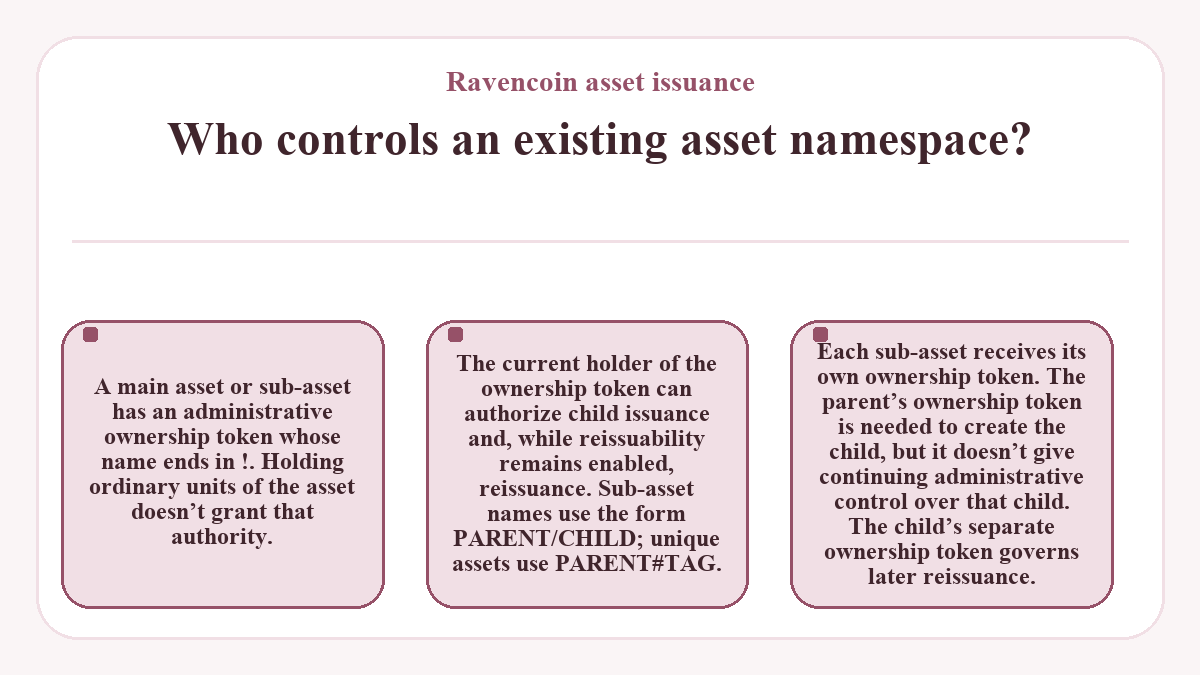
Who controls an existing asset namespace?
A main asset or sub-asset has an administrative ownership token whose name ends in
!
. Holding ordinary units of the asset doesn’t grant that authority. The current holder of the ownership token can authorize child issuance and, while reissuability remains enabled, reissuance.
Sub-asset names use the form
PARENT/CHILD
; unique assets use
PARENT#TAG
. Each sub-asset receives its own ownership token. The parent’s ownership token is needed to create the child, but it doesn’t give continuing administrative control over that child. The child’s separate ownership token governs later reissuance.
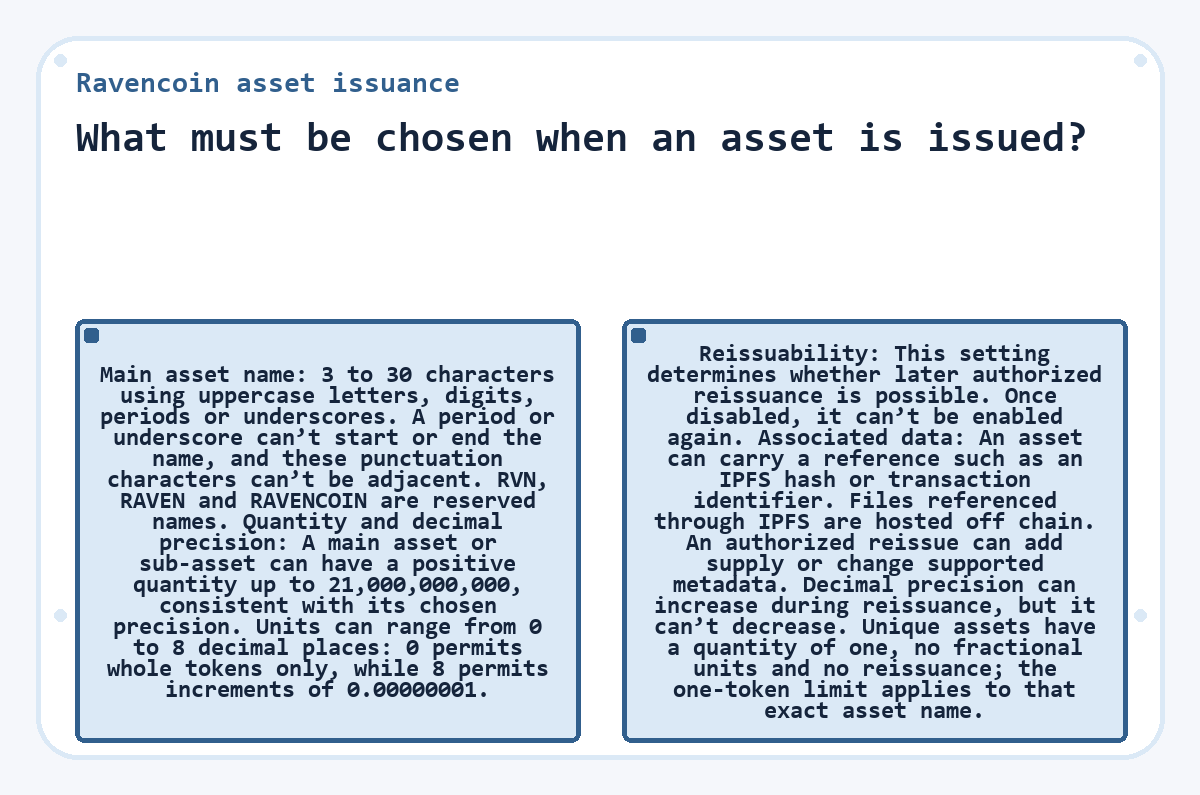
What must be chosen when an asset is issued?
- Main asset name
-
3 to 30 characters using uppercase letters, digits, periods or underscores. A period or underscore can’t start or end the name, and these punctuation characters can’t be adjacent.
RVN,RAVENandRAVENCOINare reserved names. - Quantity and decimal precision
- A main asset or sub-asset can have a positive quantity up to 21,000,000,000, consistent with its chosen precision. Units can range from 0 to 8 decimal places: 0 permits whole tokens only, while 8 permits increments of 0.00000001.
- Reissuability
- This setting determines whether later authorized reissuance is possible. Once disabled, it can’t be enabled again.
- Associated data
- An asset can carry a reference such as an IPFS hash or transaction identifier. Files referenced through IPFS are hosted off chain.
An authorized reissue can add supply or change supported metadata. Decimal precision can increase during reissuance, but it can’t decrease. Unique assets have a quantity of one, no fractional units and no reissuance; the one-token limit applies to that exact asset name.
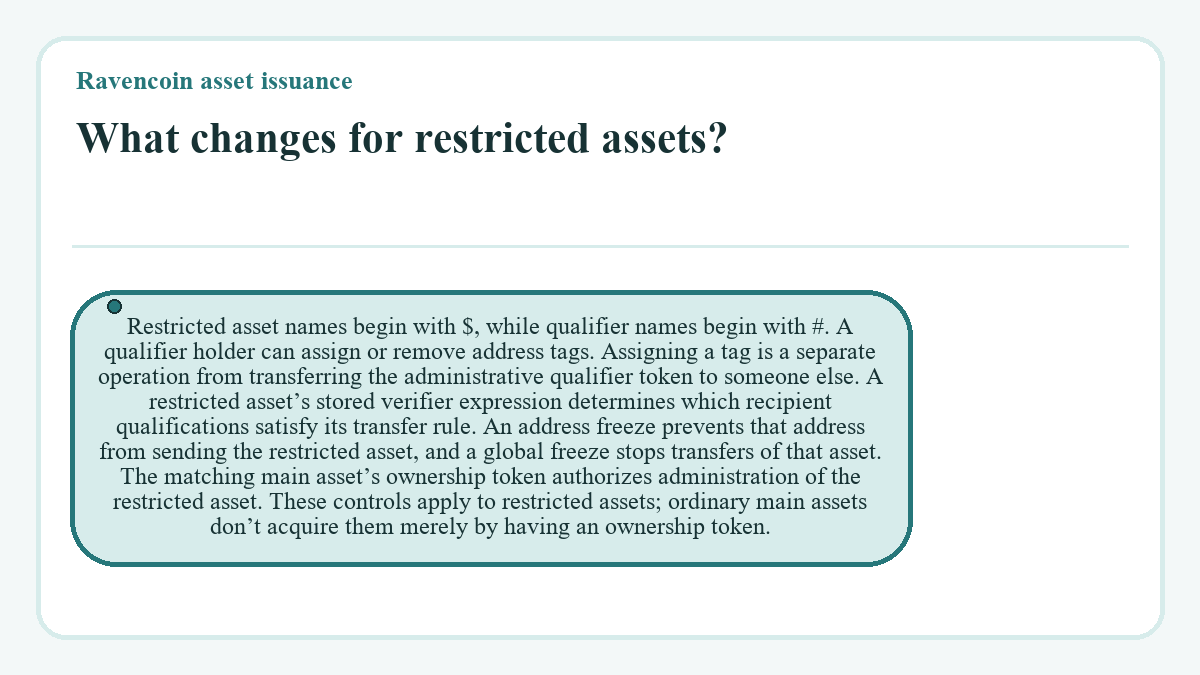
What changes for restricted assets?
Restricted asset names begin with
$
, while qualifier names begin with
#
. A qualifier holder can assign or remove address tags. Assigning a tag is a separate operation from transferring the administrative qualifier token to someone else.
A restricted asset’s stored verifier expression determines which recipient qualifications satisfy its transfer rule. An address freeze prevents that address from sending the restricted asset, and a global freeze stops transfers of that asset. The matching main asset’s ownership token authorizes administration of the restricted asset. These controls apply to restricted assets; ordinary main assets don’t acquire them merely by having an ownership token.
What does the wallet need before issuance?
The wallet needs spendable RVN for the applicable burn and the separate transaction fee, together with any required administrative token. An asset balance can’t substitute for the RVN that pays those costs.
For older Core nodes affected by the August 2026 chain split, software readiness also includes the consensus fixes. Tron Black’s August 14, 2026 report on the KAWPOW consensus bug describes v4.8.0 as combining validation of the declared block height against its chain position and checkpoint 4487775 with the asset-transfer overflow fix. The earlier v4.6.1.1-hf1 hotfix lacked that overflow fix.
The wallet-enabled
Core asset RPC commands
include
issue
for main assets, sub-assets and unique assets.
issueunique
supports issuing unique assets under a common parent. Qualifier issuance uses
issuequalifierasset
, while restricted issuance uses
issuerestrictedasset
.
Updated