 Ravencoin
 use cases
Ravencoin is a blockchain for creating and transferring named asset tokens. Its uses range from digital art and event tickets to shares and claims on custodied goods. The fit depends on whether each token must be distinct, whether supply can grow and who recognizes the entitlement that the token represents.
- Individually identified items
- Unique assets have a supply of one, can’t be divided and can’t be reissued.
- Interchangeable units
- Main assets and sub-assets support quantities with chosen divisibility and an optional ability to reissue.
- Recipient restrictions
- Restricted assets add qualifier-based recipient rules and administrative transfer controls.
Artwork and editions
For an individually identified collectible, a unique asset provides a distinct on-chain identity. Its one-token limit applies to that exact asset name; it doesn’t certify the referenced work’s originality or define the holder’s rights. An edition with interchangeable units can instead use a main asset or sub-asset. Disabling reissuability prevents further issuance of that asset, and that decision can’t be reversed.
An asset can carry an IPFS reference to an artwork file stored off chain. Keeping the file accessible remains a hosting dependency. A unique token’s scarcity and the availability of its associated artwork are separate properties.
Tickets and admission rights
A shared asset with whole units fits admission rights that are interchangeable. Unique assets fit tickets that need separate on-chain identities. A token transfer records a change of control between addresses; the organizer’s system must recognize that asset for it to serve as an entry credential.
Admission, resale and redemption rules remain part of the ticketing arrangement. A valid token balance doesn’t itself record that a person entered the venue or establish that an entitlement has been used.
Game items and service access
Main assets and sub-assets can represent in-game currency or quantities of the same item; unique assets can identify individual collectibles. Ravencoin allows those tokens to move between addresses outside a game’s account system. Their in-game effect still depends on the game’s support for the particular asset.
Service access tokens have a similar dependency: the service defines what the token unlocks. Transferability on Ravencoin doesn’t establish that another game or service accepts it.
Shares and holder distributions
Ravencoin supports tokens that represent company shares or partnership interests, alongside distributions in RVN to token holders. The issuer’s arrangements determine the associated rights and payment terms. A token balance doesn’t create an automatic RVN payout.
For shares whose transfers require recipient eligibility, restricted assets can apply qualifier-based conditions to receiving addresses. Administrative controls can also freeze transfers of that asset from a particular address or freeze movements of the restricted asset globally. A main asset or sub-asset can suit transferable units that don’t need these recipient controls.
Qualifier assets carry the authority to tag addresses. Transferring a qualifier asset therefore hands over a different power from transferring a share token; receiving an eligibility tag and holding the administrative asset aren’t the same role.
Custodied goods and redeemable credits
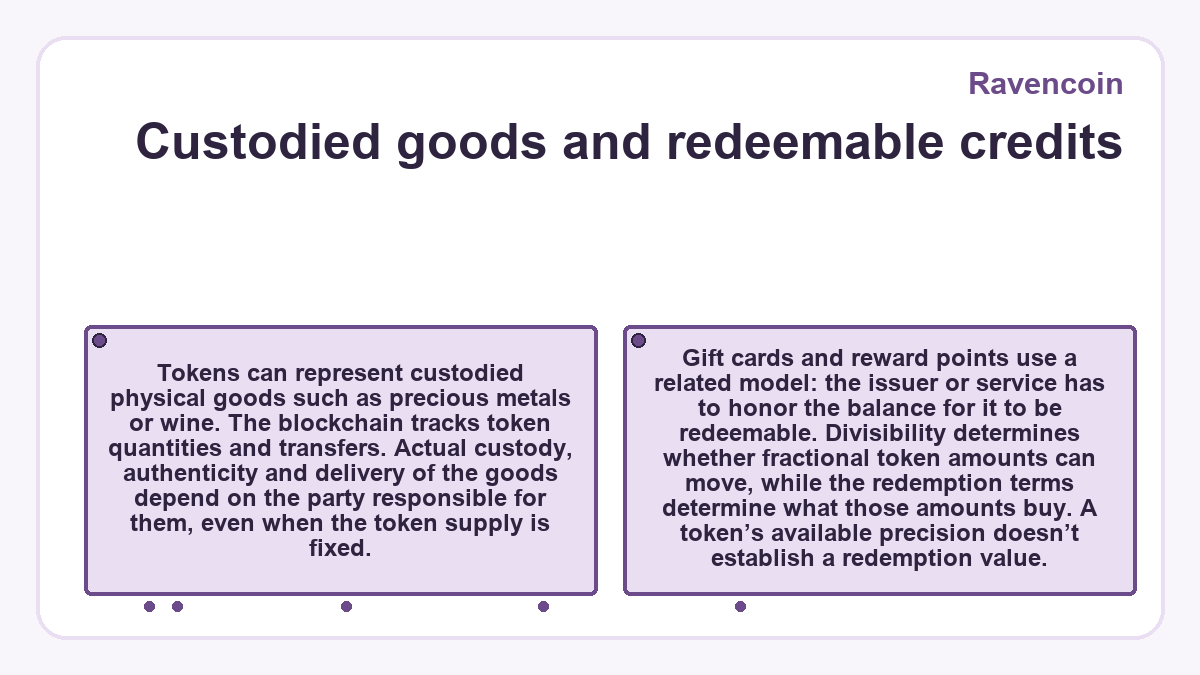
Tokens can represent custodied physical goods such as precious metals or wine. The blockchain tracks token quantities and transfers. Actual custody, authenticity and delivery of the goods depend on the party responsible for them, even when the token supply is fixed.
Gift cards and reward points use a related model: the issuer or service has to honor the balance for it to be redeemable. Divisibility determines whether fractional token amounts can move, while the redemption terms determine what those amounts buy. A token’s available precision doesn’t establish a redemption value.
Asset settings and RVN costs
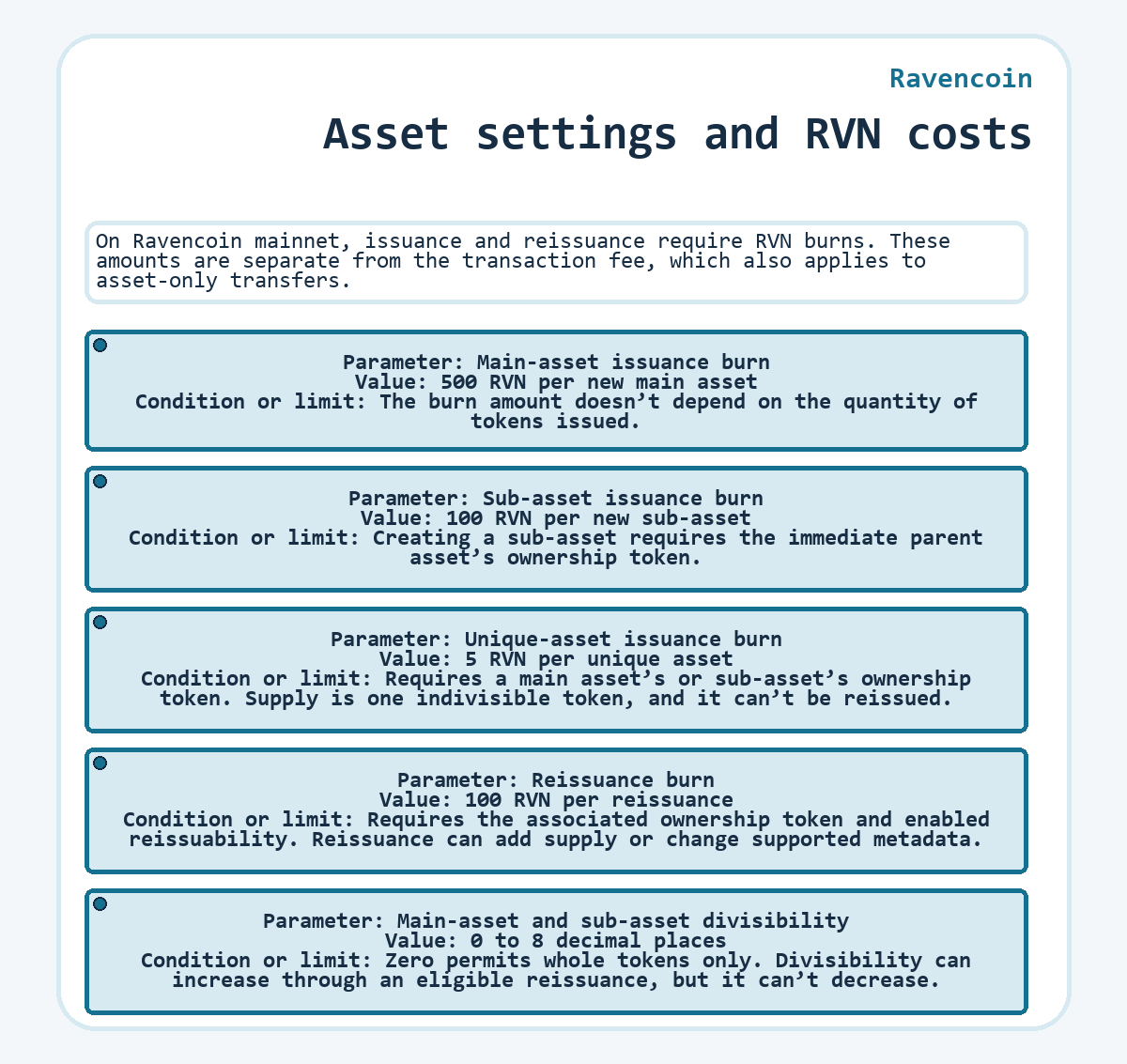
On Ravencoin mainnet, issuance and reissuance require RVN burns. These amounts are separate from the transaction fee, which also applies to asset-only transfers.
| Parameter | Value | Condition or limit |
|---|---|---|
| Main-asset issuance burn | 500 RVN per new main asset | The burn amount doesn’t depend on the quantity of tokens issued. |
| Sub-asset issuance burn | 100 RVN per new sub-asset | Creating a sub-asset requires the immediate parent asset’s ownership token. |
| Unique-asset issuance burn | 5 RVN per unique asset | Requires a main asset’s or sub-asset’s ownership token. Supply is one indivisible token, and it can’t be reissued. |
| Reissuance burn | 100 RVN per reissuance | Requires the associated ownership token and enabled reissuability. Reissuance can add supply or change supported metadata. |
| Main-asset and sub-asset divisibility | 0 to 8 decimal places | Zero permits whole tokens only. Divisibility can increase through an eligible reissuance, but it can’t decrease. |
Transfers affected by the August 2026 chain split
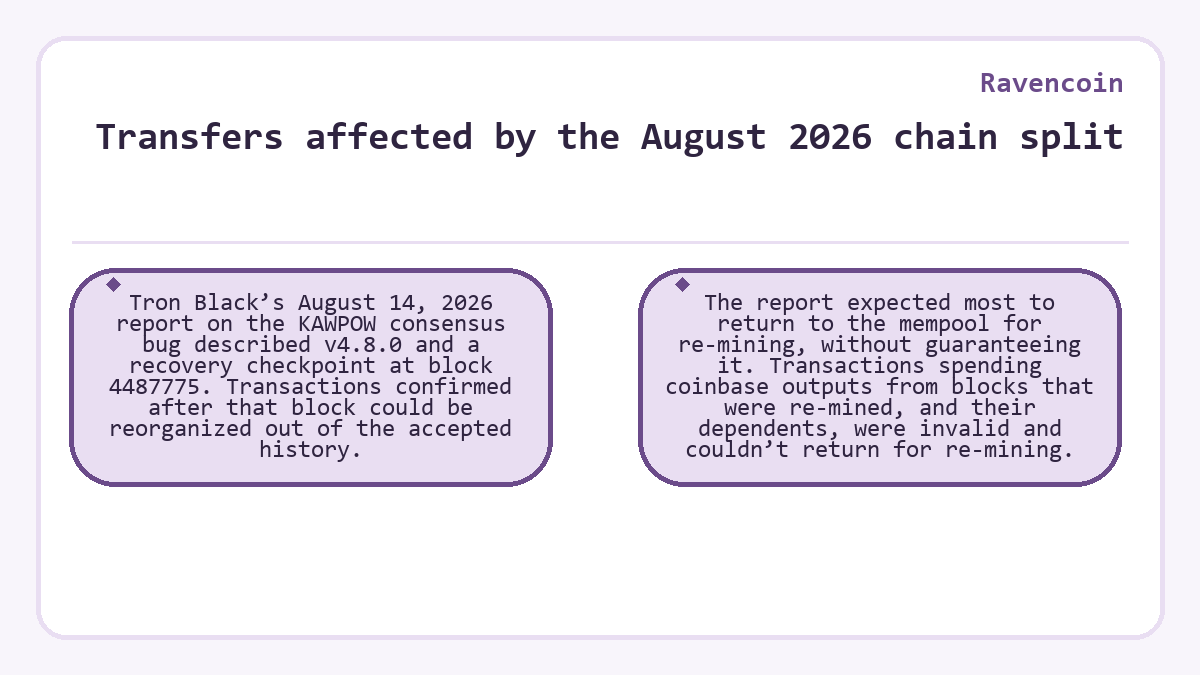
Tron Black’s August 14, 2026 report on the KAWPOW consensus bug described v4.8.0 and a recovery checkpoint at block 4487775. Transactions confirmed after that block could be reorganized out of the accepted history. The report expected most to return to the mempool for re-mining, without guaranteeing it. Transactions spending coinbase outputs from blocks that were re-mined, and their dependents, were invalid and couldn’t return for re-mining.
Updated